















Pineau des Charentes is a real gem of Charente wine heritage. This liqueur wine is the result of a clever blend of grape must and Cognac brandy. It seduces with its sweetness and aromatic richness.
History of Pineau des Charentes
Legend has it that a Charente winemaker inadvertently invented Pineau in 1589. He poured grape juice into a barrel, unaware that it already contained a bit of Cognac brandy. A few years later, he discovered this delicious nectar.
What is the AOC Pineau des Charentes?
Pineau des Charentes, like Cognac , has held the Appellation d'Origine Contrôlée (AOC) designation since 1945. This label is much stricter than the Indication Géographique Protégée (IGP) awarded to Charentais wines . It delimits a precise production area and defines the specific know-how and local practices linked to the terroir. For a Pineau to qualify for the AOC, the grape must and Cognac must come from the same vineyard.
Moreover, the respective AOC zones of Cognac and Pineau correspond with perfect accuracy. From a very large western half of the Charente department, they encompass the whole of Charente-Maritime, passing through the Royan Atlantique vineyards , and finally extend northward onto the southern fringe of Deux-Sèvres, and southward onto a very small area located on the edge of Dordogne.

What grape varieties are used for Pineau des Charentes?
For the white Pineaux:
- the colombard
- the white ugni
- the crazy white woman
For the red Pineaux:
- merlot
- Cabernet Sauvignon
- cabernet franc
How is Pineau des Charentes made?
1. The grape harvest

Pineau des Charentes is made only during the grape harvest (September-October) because it requires fresh grape must. The precise timing of the harvest is crucial. The winemaker selects the grapes according to their ripeness, measured by their sugar and acidity levels.
Sugar gives Pineau its roundness , while acidity provides a certain freshness —the perfect balance for a fortified wine that is neither too heavy nor too sweet. The sugar and acidity levels depend on the grape varieties used, but also on the timing of the harvest. The later the harvest, the higher the sugar concentration. Conversely, the earlier the harvest, the higher the acidity.
2. Pressing or pressing
After separating the grape berries from their stalks (stems that hold the grapes), they are sent to a cylindrical pneumatic press. Then, a balloon is gradually inflated inside to gently press them against the wall.
The extraction of grape must, or pressing, takes place immediately after the harvest to produce white Pineau, and after several hours of maceration of the grapes with their skins to obtain red Pineau. Indeed, it is the contact of the grape skins with the juice that colors the wine . Thus, to obtain rosé Pineau, the grapes are simply left to macerate for a shorter time with their skins in order to obtain a less colored must.
3. Mutation and mixing
The fresh juice is immediately blended in vats with young Cognac brandy. This blend stops the natural fermentation of the grapes, thus preserving the natural sugars of the must. The ratio is generally 3 parts grape must to 1 part brandy . The resulting mixture is then homogenized and aged.
4. Aging and bottling

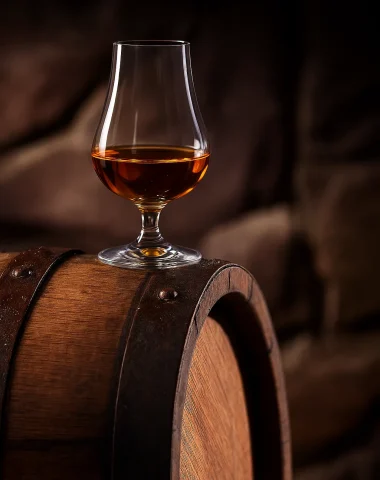
Pineau is aged exclusively in oak barrels . The producer determines the aging period according to the grape variety used and the desired character:
- 8 months for red or rosé Pineau
- 12 months minimum for white Pineau
- 5 years minimum for an old Pineau
- 12 years minimum for an extra old Pineau
Finally, to qualify for the AOC designation, bottling must take place in the production region. The alcohol content of Pineau then ranges between 16° and 22°.
Pineau, the traditional aperitif of Charente-Maritime
Character and taste of Pineau
Since its emergence in the 16th century , Pineau des Charentes has established itself as one of the flagship specialties of the Charente region . However, differences in taste can be distinguished depending on the aging period. Younger Pineaus have more acidity and freshness. Their aromas are fruity but fairly simple. Older Pineaus , on the other hand, develop more complex aromas. They exhibit a certain roundness with notes of dried fruit and spices . They also have a longer finish.

How do you drink Pineau des Charentes?
- White, rosé or red, Pineau des Charentes is best enjoyed chilled, just as much as an aperitif or as an accompaniment to desserts, offering fruity, delicately woody flavors.
- With its nutty taste and vanilla flavors, old Pineau also goes well with foie gras, or even cheeses, in particular blue cheeses.
- An old or very old Pineau can be served at room temperature, just chilled, as a digestive after dinner.
- Finally, Pineau des Charentes is now available cocktail. Indeed, consumer habits are changing and this new fashion allows it to be brought up to date and its image to be dusted off.


Meetings with Pineau des Charentes producers
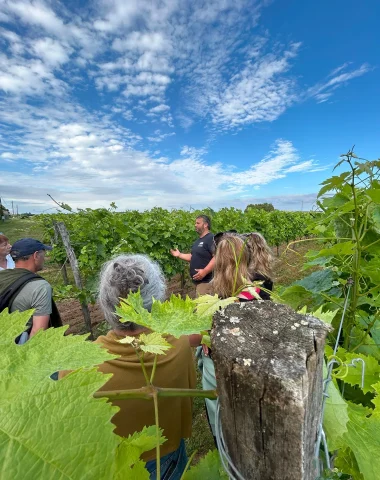
Behind every bottle, there are faces, gestures, and stories. To discover Pineau des Charentes in a different way, you have to meet those who produce it with passion. On their land, in their cellars, they share their craft, their traditions, and that little extra soul that makes all the difference. Ready to step inside the estate?
The Field of Vines
Guerin family
Alcohol abuse is dangerous for health. To consume with moderation.